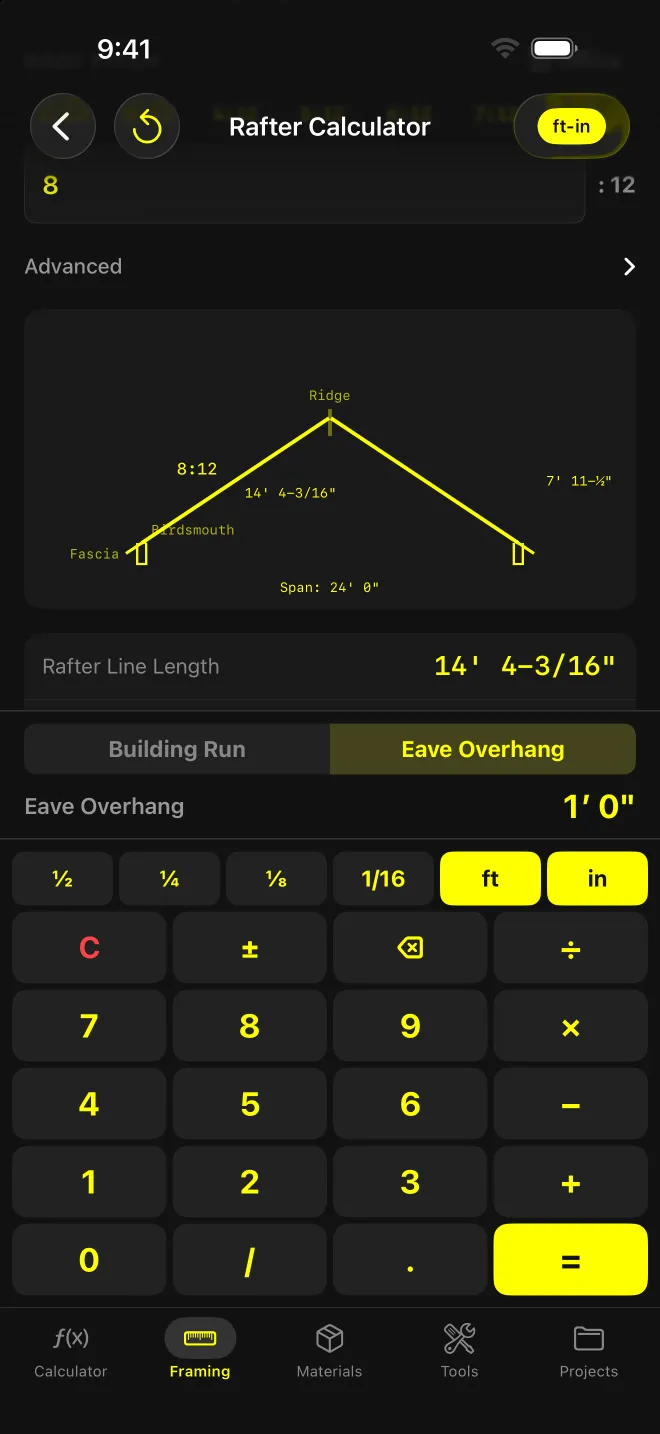
What does the rafter screen solve?
Pitch and building run in, cut lengths and angles out, for the four rafters on a hip roof. A segmented control at the top switches between Common, Hip/Valley, Jack and Irregular. The inputs carry over, so you can set up the roof once and step through every rafter on it.
Inputs
Roof Pitch: presets for 2, 3, 4, 5, 6, 7, 8, 9, 10 and 12 on 12, or type any rise per 12 in the field. The Device button reads pitch from the phone’s tilt and locks it in.
Building Run and Eave Overhang use the feet-inch-fraction keypad. Run is half the span. The app reports the span back as a result.
Under Advanced: Ridge Thickness (1.5” default), Rafter Depth (5.5”, a 2×6) and HAP — Height Above Plate (blank means auto, 2/3 of rafter depth). Jack adds Jack Spacing OC (16” default). Irregular adds Adjacent Pitch.
Coming from the Right Triangle solver? Its → Rafter button fills Building Run with the triangle’s run and sets pitch to rise ÷ run × 12.
What each mode returns
Common
Rafter Line Length, Total Rafter Length, Tail Length, Total Rise, Pitch Angle, Ridge Cut, Birdsmouth Seat, Birdsmouth Plumb, HAP and Span. The roof cross-section draws as you type, labeled with pitch, rafter length, rise, span, ridge, birdsmouth and fascia. The PDF adds Adjusted Run and Unit Line Length per 12”.
Hip/Valley
Hip Run, Hip Line Length, Hip Total Length, Hip Tail, Hip Pitch (rise per 17), Hip Pitch Angle, Backing Angle, Cheek Cut and Total Rise. Exports to PDF.
Jack
Length Difference, Side Cut Angle, Jack Count per side, Pitch Angle, and a numbered list with every jack’s length, shortest first.
Irregular
For two roof planes at different pitches meeting at a 90° corner: Plan Angle (Main) and (Adjacent), Hip Run, Hip Line Length, Hip Pitch Angle, Adjacent Run, Backing and Cheek Cut for each side, and Total Rise.
Worked example: 24’ span, 8:12, 12” overhang
Building Run is 12’ (144”). Ridge Thickness stays at the 1.5” default, so the app takes half of it off the run: 144 − 0.75 = 143.25”.
- Unit line length: √(12² + 8²) = 14.4222” per 12” of run
- Rafter Line Length: 143.25 × 14.4222 ÷ 12 = 172.17” = 14’ 4-3/16”
- Tail Length: 12 × 14.4222 ÷ 12 = 1’ 2-7/16”
- Total Rafter Length: 15’ 6-9/16”
- Total Rise: 143.25 × 8 ÷ 12 = 7’ 11-1/2”
- Pitch Angle / Ridge Cut: 33.69°
Same roof on the other tabs. Jack at 16” OC: 16 × 14.4222 ÷ 12 = 1’ 7-1/4” length difference, 8 jacks per side, 39.76° side cut. Hip/Valley: Hip Pitch 8:17, Hip Line Length 18’ 7-15/16”.
Assumptions and limits
- Line lengths are theoretical. The only deduction is half the ridge thickness (× √2 on the hip). Jack lengths take nothing off for hip or valley thickness. Shorten at layout.
- Hip/Valley assumes equal pitches and a 90° corner. Hips and valleys use the same math, and the hip tail assumes the same overhang on both walls. Unequal pitches go on the Irregular tab.
- Irregular returns line length only. No tail, no PDF.
- Birdsmouth Plumb is Rafter Depth − HAP. Birdsmouth Seat is that number ÷ (pitch ÷ 12). The app subtracts HAP from the board’s actual depth, not the taller plumb-line depth at pitch, so lay the birdsmouth out on the stick and confirm the seat bears on the plate.
- Drawing is Common only. PDF covers Common and Hip/Valley.
- The screen shows “Per IRC 2024 R802” with “Reference only — verify with local code and a licensed professional.” It doesn’t size rafters or check spans.
→ Materials sends Total Rafter Length to the Board Feet calculator for pricing.
Web calculator or app?
The free roof pitch calculator converts between pitch, degrees and slope factor. It’s enough when you only need the angle or the multiplier. When you’re cutting rafters, the app gives the ridge and birdsmouth cuts, hip backing and cheek angles, and every jack length in one place.