How to Lay Out and Cut Rafter Birdsmouth Joints
Understanding the Birdsmouth Joint
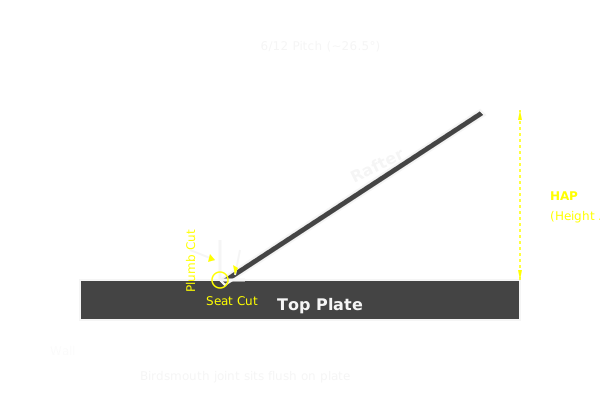
The birdsmouth is the notch cut into a rafter where it bears on the top plate of the wall. It consists of two cuts:
- Plumb cut (or cheek cut): Vertical cut facing the interior of the building
- Seat cut (or heel cut): Horizontal cut that bears on the wall top plate
When properly cut and installed, the birdsmouth distributes rafter load across the plate and prevents the rafter from splitting at the bearing point. A poorly designed birdsmouth can fail—either the rafter cracks above the notch or the bearing becomes inadequate.
The IRC Depth Limit: The Most Critical Rule
IRC R802.7.1 states: The seat cut depth cannot exceed 1/3 of the rafter depth.
For common rafter sizes:
| Rafter Size | Full Depth | Max Seat Cut Depth |
|---|---|---|
| 2x6 | 5.5” | 1.83” (1.75” practical) |
| 2x8 | 7.25” | 2.42” (2.4” practical) |
| 2x10 | 9.25” | 3.08” (3” practical) |
| 2x12 | 11.25” | 3.75” |
Why the limit? Cutting too deep removes too much bearing area and leaves insufficient wood above the cut. The rafter becomes a lever that splits at the birdsmouth. Buildings have failed because carpenters cut deep seats to minimize plumb cut angle.
Always verify your rafter size on the plans and check depth limits before cutting.
Calculating HAP (Height Above Plate)
HAP is the vertical distance from the top plate to the bottom of the rafter at the seat cut. It determines the balance of the two birdsmouth cuts.
The relationship is:
Seat cut depth = (Rafter rise/run) × HAP
HAP = Seat cut depth ÷ (Rafter rise/run)
Example: 6/12 pitch rafter, target 1.5” seat cut depth
6/12 pitch = 6” rise per 12” run = 0.5 rise per 1” run
HAP = 1.5” ÷ 0.5 = 3.0”
So the rafter sits 3” above the plate (measured vertically from plate top to rafter bottom).
Common HAP values by pitch:
| Pitch | Rise/Run | HAP for 1” Seat | HAP for 1.5” Seat | HAP for 2” Seat |
|---|---|---|---|---|
| 4/12 | 0.333 | 3.0” | 4.5” | 6.0” |
| 5/12 | 0.417 | 2.4” | 3.6” | 4.8” |
| 6/12 | 0.500 | 2.0” | 3.0” | 4.0” |
| 7/12 | 0.583 | 1.72” | 2.57” | 3.43” |
| 8/12 | 0.667 | 1.5” | 2.25” | 3.0” |
| 10/12 | 0.833 | 1.2” | 1.8” | 2.4” |
| 12/12 | 1.0 | 1.0” | 1.5” | 2.0” |
Design approach: Pick a seat cut depth that:
- Doesn’t exceed 1/3 rafter depth (IRC limit)
- Provides at least 3-4” bearing length on the plate
- Keeps plumb cut angle reasonable (not excessively steep)
For most residential rafters (6/12 to 8/12 pitch), a 1.5” to 2” seat works well.
Layout on the Rafter: Three-Step Method
Step 1: Mark the Plumb Line (Roof Slope)
Using a speed square and pencil:
- Place speed square with the pitch in the corner notch (e.g., 6 for a 6/12 pitch)
- The square’s hypotenuse aligns with the rafter top edge
- Mark a line down the rafter perpendicular to the top edge
- This is the plumb line at the ridge
For the birdsmouth, mark the plumb line at the bearing end of the rafter (same angle as the ridge plumb cut).
Speed square setup:
- The square has a corner notch marked with pitch numbers (4, 5, 6, etc.)
- Place the notch on the rafter edge
- The pitch number should align with the rafter top
- The other edge of the square gives you the plumb line
Step 2: Mark the Seat Line (Level Line)
From the plumb line, measure down the rafter a distance equal to the HAP. Draw a line perpendicular to the rafter’s length at this point.
This is the seat line and should be horizontal (level) when the rafter is installed.
Marking with the speed square:
- From the plumb line mark, measure down the rafter length by the HAP value
- Place the speed square’s level edge at this point
- Mark a line across the rafter perpendicular to its length
- This is your seat line
Step 3: Mark the Seat Cut Depth
From the bottom edge of the rafter, measure up toward the top a distance equal to the seat cut depth. The point where this vertical measurement meets the seat line is your seat cut depth endpoint.
Simple method:
- At the plumb line, mark the seat cut depth vertically (e.g., 1.5”)
- From the seat line down, mark the same distance (1.5” for 1.5” seat)
- Connect these marks with a diagonal line—this is your seat cut line
The birdsmouth now has:
- Plumb cut: From the top of the rafter down to where the 1.5” mark meets the plumb line
- Seat cut: From that point diagonally to where the seat line hits the bottom of the rafter
Marking with Speed Square: Detailed Process
For a 6/12 pitch rafter with 3” HAP and 1.5” seat depth:
-
Identify the bird line (where the birdsmouth is located along the rafter length, usually 16-24” from the bird’s mouth, measured along the rafter):
- Measure along the rafter from the tail
- This distance is determined by overhang and seat support location
-
At the bird line, mark the plumb line:
- Place speed square with 6 in the notch corner
- Align 6 with the top edge of the rafter
- Draw a vertical line down the rafter
-
Measure down the rafter 3 inches (HAP):
- From the plumb line, measure 3” down the rafter length
- This is where the seat line intersects the plumb line
-
Mark the seat line:
- At the 3” mark, draw a perpendicular line across the rafter
- This line represents the top of the bearing (where the plate touches)
-
Mark seat cut depth:
- From the top of the rafter at the plumb line, measure down 1.5” perpendicular to the rafter top
- From the seat line, measure down 1.5” perpendicular to the rafter length
- Connect these two points with a diagonal line
- This diagonal is your seat cut line
-
Mark the heel line:
- The heel line is the corner where plumb cut meets seat cut
- It should fall on the plate when installed
Common Birdsmouth Configurations
Standard Roof (6/12 pitch, no overhang):
- Plumb cut: 33.7° from vertical (calculated from pitch)
- Seat cut: 1.5” depth
- HAP: 3”
- Bearing on plate: Approximately 4” along the plate surface
Saltbox or Cathedral Roof (Steeper pitch, 10/12):
- Plumb cut: 39.8° from vertical (steeper angle)
- Seat cut: 1.5” depth (may be only 1” due to rafter depth)
- HAP: 1.8”
- Bearing: Approximately 2.5” along the plate
Low-pitch Roof (4/12, wide overhangs):
- Plumb cut: 18.4° from vertical (nearly flat)
- Seat cut: 1.5” to 2” (more latitude for depth)
- HAP: 4.5” to 6” (larger vertical distance)
- Bearing: Approximately 5-6” along the plate
Avoiding Common Cutting Mistakes
Problem: Plumb cut and seat cut don’t meet
This happens when one line is marked incorrectly. The two cuts must meet at a point (the heel). If they don’t:
- Re-mark the plumb line using the speed square
- Verify the seat line is truly perpendicular to the rafter length
- Ensure HAP measurement is accurate
Problem: Rafter rocks on the plate (bearing area too small)
Seat cut is too shallow or HAP is too large. The rafter needs 3-4 inches of bearing length along the plate top.
If bearing is marginal:
- Decrease HAP (but this deepens seat cut—check IRC limit)
- Use a larger seat cut depth (but this increases compressive force at the heel)
- Add a rafter tie or collar tie for lateral support
Problem: Rafter cracks above the birdsmouth
The seat cut was cut too deep, removing more than 1/3 of rafter depth. This is the most common failure mode.
- Measure the rafter depth and verify 1/3 limit
- For 2x8, max seat is 2.4” (measure actual, not nominal)
- If existing rafters have deep cuts, reinforce with sistering or metal straps per engineer
Problem: Marking is off by 1/8”, rafter won’t fit
Speed square or measuring error. For production cutting (multiple rafters):
- Cut one test rafter
- Fit it on the building
- Mark and adjust if needed
- Use that rafter as a template for remaining cuts (trace the birdsmouth onto new stock)
IRC Requirements and Bearing
IRC R802.7 specifies:
- Rafters must have a minimum 1.5” bearing on wall plates
- Seat cut depth maximum is 1/3 rafter depth
- Plumb cuts must be at the appropriate angle for roof pitch
The 1.5” minimum bearing applies to the depth of contact along the plate (not the HAP). A properly designed birdsmouth provides 3-5” of bearing length, which is more than adequate.
Framing Connections at Birdsmouth
After cutting, fasten the rafter to the plate:
Standard connection:
- Two 16d nails or 3” screws through the plumb cut into the top plate
- Or metal rafter tie/hurricane tie bolted to the plate
For high wind or seismic zones:
- Structural connectors required
- Verify local code for connector type and fastening
Nails alone may be insufficient in wind/seismic areas. Check your building department.
Using a Template for Efficiency
When framing multiple rafters (20-30 per roof):
- Cut one complete rafter and test fit it
- Adjust the birdsmouth if needed
- Use that rafter as a cutting template:
- Clamp it to raw lumber
- Trace around the birdsmouth with a pencil
- Cut remaining rafters to the traced lines
- Speed and accuracy improve dramatically
- Ensure consistency across all rafters
Templates save time and eliminate marking errors.
Quick Reference: Standard Configuration
For residential 6/12 roof, 2x8 or 2x10 rafter:
| Parameter | Value |
|---|---|
| Pitch | 6/12 |
| Plumb cut angle | 33.7° |
| Seat cut depth | 1.5” |
| HAP (height above plate) | 3.0” |
| Minimum bearing on plate | 1.5” (code min) |
| Typical bearing length | 3-4” |
| Speed square setting | 6 in notch corner |
Marking sequence:
- Speed square plumb line at bird cut location
- Measure 3” down rafter from plumb line
- Draw seat line perpendicular to rafter
- Mark 1.5” down from top at plumb line
- Mark 1.5” down from seat line
- Connect for diagonal seat cut line
- Cut plumb first, then seat
- Test fit before cutting remaining rafters
The birdsmouth is critical. Don’t skip the IRC depth check. A rafter that cracks above the notch can collapse and compromise roof integrity. Taking time to layout and cut properly prevents callbacks and building failures.