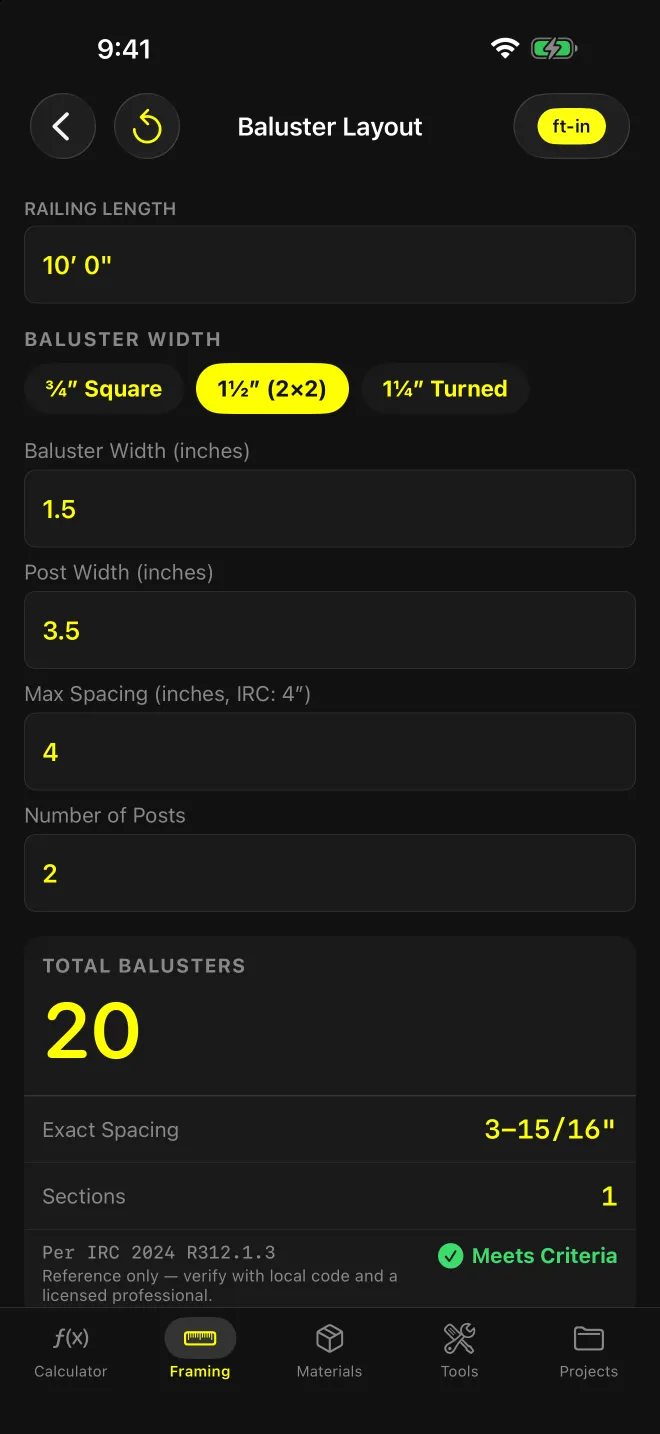
What does this screen solve?
Ten feet of deck rail, 2×2 balusters, 4×4 posts. How many balusters, and what gap makes every space equal? Laying it out with a tape usually ends with one fat gap against the last post.
This screen gives the count and one exact gap for every space, including the two against the posts. Then it checks that gap against the 4” sphere rule.
What goes in, and what comes out?
Inputs
- Railing length on the feet-inch-fraction keypad. Overall length, outside face of the first post to outside face of the last. The app subtracts every post.
- Baluster width: chips for ¾” Square, 1½” (2×2) and 1¼” Turned, or type any width in inches.
- Post width in inches. 3.5 for a 4×4, 5.5 for a 6×6.
- Max spacing in inches. The field is labeled “IRC: 4″”.
- Number of posts, 2 or more. Sections = posts − 1.
Outputs
- Total balusters, with the per-section count when there’s more than one section.
- Exact spacing: the clear gap between balusters, and between the end balusters and the posts.
- Sections.
- IRC 2024 R312.1.3: “Meets Criteria” or “Exceeds 4″”.
The format pill switches the spacing between feet-inch-fraction, decimal inches and the app’s other formats. Save and Share sit under the result.
Worked example: 10’ rail, 2×2 balusters
Inputs from the screenshot: 10’ 0” railing, 1½” balusters, 3.5” posts, 4” max, 2 posts.
Clear span between post faces: 120” − 2 × 3.5” = 113”.
The span holds n balusters and n + 1 gaps: clear span = n × width + (n + 1) × gap. The app solves for the fewest balusters that keep the gap at or under 4”:
- n ≥ (113 − 4) ÷ (1.5 + 4) = 19.82 → 20 balusters
- gap = (113 − 20 × 1.5) ÷ 21 = 83 ÷ 21 = 3.952” → 3-15/16”
One section, 20 balusters, “Per IRC 2024 R312.1.3 — Meets Criteria”.
Why does the last 1/16” matter?
3-15/16” is 3.952” rounded down 0.015” to the nearest sixteenth. Over 21 gaps that adds up to 5/16”. Cut a spacer at 3-15/16”, run it post to post, and the last gap opens to 4-¼”. That fails the sphere test.
Split the 5/16” across a few gaps, or flip the format pill to decimal inches (3.952 in) and mark a story pole. If you lay out on center, it’s 1½” + 3.952” = 5.452”, about 5-7/16” (the app doesn’t show on-center; add it in the Feet-Inch-Fraction Calculator).
What does it assume?
Equal sections. With 3 or more posts, the clear span is split evenly: (length − posts × post width) ÷ sections. Posts at uneven spacing need one run per section, with 2 posts each.
Same width on every post. One post-width field covers all of them.
Fewest balusters that pass. It never adds an extra one for a tighter look. Want gaps near 3½”? Type 3.5 in Max Spacing and it solves for that.
The code check is a confirmation, not an inspection. The count is always solved to your Max Spacing value, and the pass/fail compares against that field, not a fixed 4” (type 4.5 and it still reads Meets Criteria). Leave it at 4 if you want the IRC line to mean something.
Gap only. It checks baluster-to-baluster and baluster-to-post. Guard height and the opening under the bottom rail aren’t on this screen. The app’s own note: “Reference only — verify with local code and a licensed professional.”