What do these two screens solve?
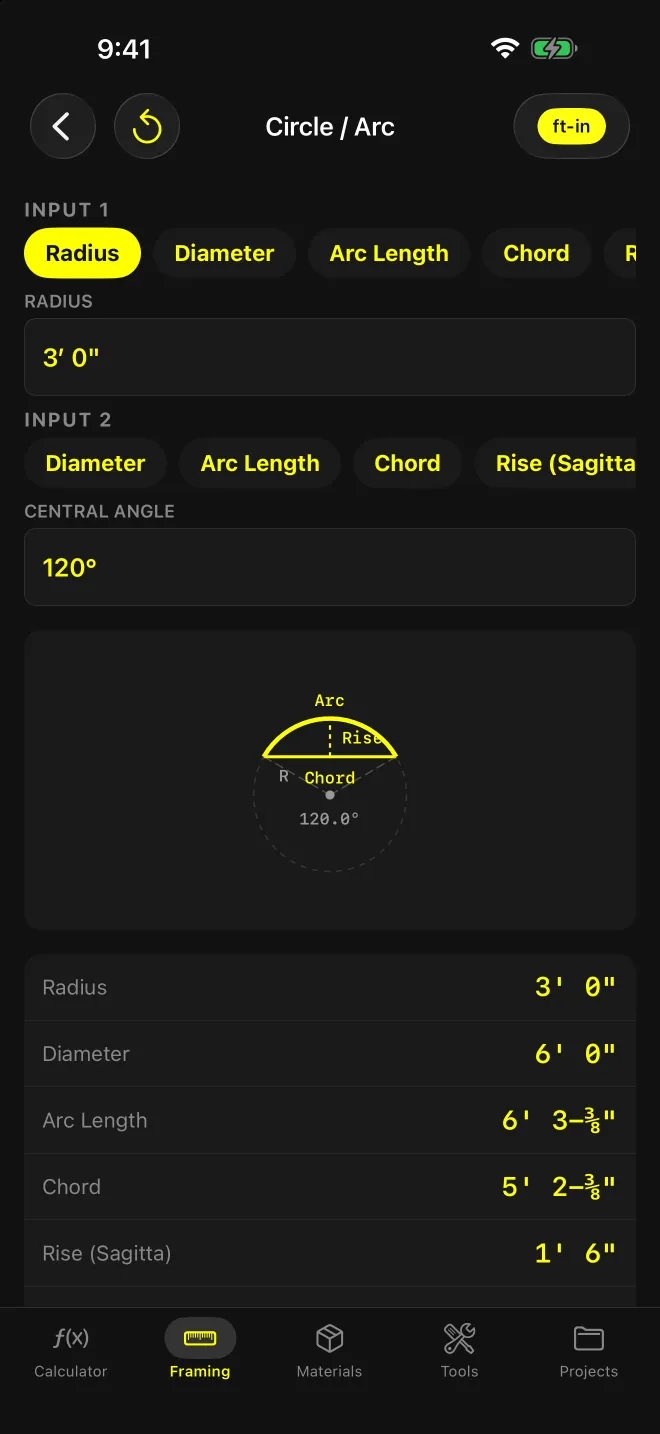
Arched window head, curved soffit, radius wall plate. You know two dimensions and need the radius to swing a trammel, or the arc length to order flex trim. Circle / Arc takes any two of six values and returns the rest.
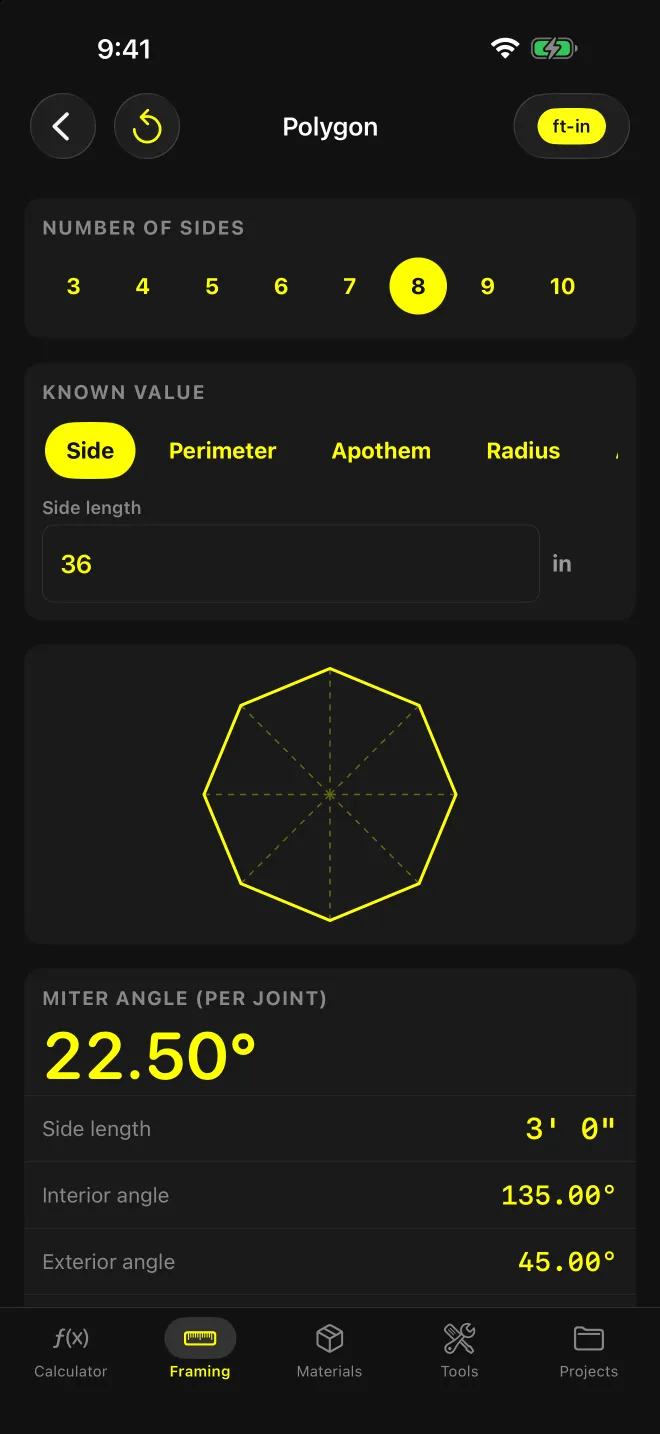
Gazebo, octagon deck, bay window, turret. Polygon gives the saw setting per joint and every dimension of a regular polygon from the side count plus one known value.
Circle / Arc
What goes in?
Two chip rows, Input 1 and Input 2: Radius, Diameter, Arc Length, Chord, Rise (Sagitta), Central Angle. Input 2 hides whatever Input 1 already uses. Lengths go in on the feet-inch-fraction keypad. Central Angle is a plain number in degrees.
Any pair solves except Radius + Diameter (that’s one value entered twice). Arc + Chord and Arc + Rise have no closed form, so the app solves them numerically. Chord + Rise uses R = c² ÷ 8h + h ÷ 2: the one you want when you know the opening width and how high the arch springs.
What comes out?
Ten rows: Radius, Diameter, Arc Length, Chord, Rise (Sagitta), Central Angle, Circumference, Circle Area, Sector Area, Segment Area. A drawing above them shows the arc, chord, rise and both radii.
Lengths round to the nearest 1/16” in feet-inch-fraction. Areas read in sq ft, or sq in under 1 sq ft.
Worked example: 3’ radius, 120°
θ = 120° = 2.0944 rad.
- Arc length = R × θ = 36 × 2.0944 = 75.40” → 6’ 3-⅜”
- Chord = 2R × sin(θ/2) = 72 × sin 60° = 62.35” → 5’ 2-⅜”
- Rise = R × (1 − cos(θ/2)) = 36 × 0.5 = 18” → 1’ 6”
- Diameter 6’ 0”, circumference 18’ 10-3/16”, segment area 5.53 sq ft
Polygon
What goes in?
Number of sides: chips from 3 to 20. Known value: Side, Perimeter, Apothem, Radius or Area. The field labels spell out the two that get mixed up: “Apothem (centre to side)” and “Circumradius (centre to corner)”. Lengths are decimal inches, area is sq ft.
What comes out?
Miter Angle (per joint) on top, because that’s the number that goes to the saw. Then Side length, Interior angle, Exterior angle, Perimeter, Apothem, Circumradius, and Area in sq ft and sq in. A drawing shows the outline with corner-to-centre spokes.
Worked example: octagon, 36” sides
- Miter = 180 ÷ 8 = 22.50°
- Interior = (8 − 2) × 180 ÷ 8 = 135.00°
- Exterior = 360 ÷ 8 = 45.00°
- Perimeter = 8 × 36” = 24’ 0”
- Apothem = 36 ÷ (2 × tan 22.5°) = 43.46” → 3’ 7-7/16”
- Circumradius = 36 ÷ (2 × sin 22.5°) = 47.04” → 3’ 11-1/16”
- Area = ½ × 288 × 43.46 = 6257.6 sq in = 43.46 sq ft
(Same digits as the apothem. Not a bug: half of a 288” perimeter is exactly 144.)
Each piece gets 22.5°, and two pieces close the 45° turn at every corner. Crown in a 135° corner is a compound cut. The Compound Miter calculator has a 135° corner preset for that.
What do they assume?
Circle / Arc: true circular arcs, up to a full 360°. A chord longer than the diameter or an arc longer than the circumference returns no result instead of a wrong one. Basket-handle and elliptical arches are out of scope.
Polygon: regular polygons only. Every side and every angle equal. The app’s note says it plainly: dimensions are to the theoretical polygon, with no allowance for stock thickness, kerf or joint gap. Decide which face your side length measures to before you cut eight pieces.