Rolling Offset Calculations: The Complete Guide for Pipefitters
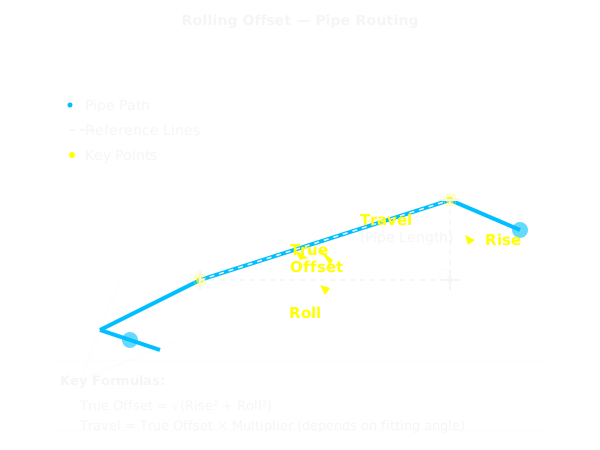
What Makes a Rolling Offset Different
A standard offset moves pipe in one plane — up, down, left, or right. A rolling offset moves pipe in two planes simultaneously — up and over, or down and sideways. This happens whenever the departure point and arrival point don’t share a common vertical or horizontal plane.
The math isn’t harder, but it adds one step: calculating the true offset before applying the standard offset formulas.
The Rolling Offset Formula
Step 1: Calculate the true offset. True Offset = √(Rise² + Roll²)
Where Rise is the vertical offset distance and Roll is the horizontal offset distance.
Step 2: Calculate the travel piece. Travel = True Offset / sin(fitting angle)
Step 3: Calculate the fitting rotation angle. Rotation = arctan(Roll / Rise)
This rotation angle tells you how much to rotate the fittings from the vertical plane to achieve the combined vertical and horizontal offset.
Worked Example: 6-Inch Rise, 8-Inch Roll at 45°
A pipe needs to rise 6 inches vertically and move 8 inches horizontally using 45° fittings.
True Offset: √(6² + 8²) = √(36 + 64) = √100 = 10 inches
Travel: 10 / sin(45°) = 10 / 0.7071 = 14.14 inches
Rotation angle: arctan(8/6) = arctan(1.333) = 53.13° from vertical
So the travel piece is 14.14 inches center-to-center, and you rotate the 45° fittings 53.13° from the vertical plane.
Worked Example: 12-Inch Rise, 12-Inch Roll at 45°
Equal rise and roll is the simplest case — the rotation angle is exactly 45°.
True Offset: √(12² + 12²) = √(144 + 144) = √288 = 16.97 inches
Travel: 16.97 / sin(45°) = 16.97 / 0.7071 = 24.0 inches
Rotation: arctan(12/12) = arctan(1.0) = 45° from vertical
Why Rolling Offsets Trip People Up
The confusion comes from visualizing the geometry. A standard offset is a flat triangle — you can draw it on paper. A rolling offset is a three-dimensional triangle — the true offset is the hypotenuse of a triangle that exists in horizontal space, and the travel piece is the hypotenuse of a second triangle that includes that true offset as one leg.
Once you separate it into two steps — (1) find the true offset in the horizontal/vertical plane, then (2) calculate travel from the true offset — the math becomes two applications of the same formulas you already know.
Measuring for Rolling Offsets
The measurement challenge is establishing the rise and roll accurately. Use a plumb bob or level to determine the true vertical rise between the centerlines of the departure and arrival positions. The roll is the horizontal distance between those same centerlines, measured perpendicular to the pipe run.
If you can hang a plumb line from the upper pipe position, the distance from the plumb line to the lower pipe is the roll. The length of the plumb line from the upper pipe to the same elevation as the lower pipe is the rise.
The Rotation in Practice
The rotation angle determines how you orient the fittings. For a pure vertical offset (no roll), the fittings face straight up and down — 0° rotation. For a pure horizontal offset (no rise), the fittings face left and right — 90° rotation. A rolling offset falls somewhere between.
To set the rotation on the fitting, mark the rotation angle from vertical on the pipe and align the fitting to that mark. A protractor or digital angle finder helps with precision. An error of even a few degrees in rotation cascades into misalignment at the far end of the travel piece.
Free pipe offset calculator → | FieldLab Pipefitter Calculator →