How to Layout Framing Walls: Studs, Headers, and Cripples
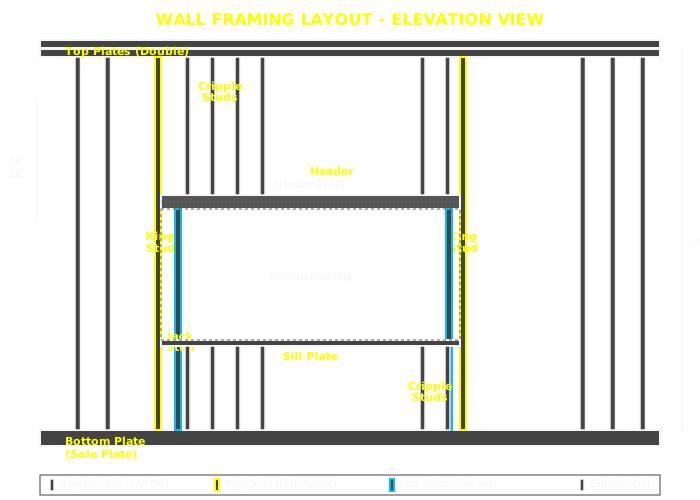
Wall Framing Layout Fundamentals
Wall layout is the roadmap for framing. Get it right on paper before cutting a stud. Layout determines:
- Joist support for floors above
- Header sizing and support
- Electrical and mechanical routing
- Drywall nailing efficiency
- Building code compliance
Most residential framing runs at 16” on-center (OC), but commercial or energy-efficient buildings use 24” OC. Both are code-compliant if designed properly, but they require different spacing approaches.
16” vs 24” On-Center: When to Use Each
16” On-Center (Standard Residential)
Used for:
- Single-story houses with truss roofs
- Two-story construction below a joist span
- Continuous load path from rafter to foundation
- Standard insulation cavities (most batts are 16” wide)
Advantages:
- Most contractors and suppliers know 16” spacing
- Electrical outlets land on studs naturally
- Better load distribution
- IRC Table R602.3.1 assumes 16” OC for most allowable wall heights
Cost: Additional studs increase material cost roughly 33% over 24” spacing.
24” On-Center (Commercial/Efficient Design)
Used for:
- Load-bearing walls in commercial buildings
- Non-load-bearing partition walls (residential or commercial)
- Two-story residential when floor joists run perpendicular and land on studs
- Walls designed by an engineer for 24” spacing
Requirements:
- Double top plate (must support rim joist load)
- Header sizing must account for 24” spacing
- Blocking may be required mid-wall if drywall doesn’t cross stud spacing
- Not recommended for first-floor exterior walls carrying roof loads (use 16” OC)
Layout Sequence: Start to Finish
Step 1: Determine Wall Length and Starting Points
Mark the full wall length on the floor or on your layout paper. Identify:
- Exterior corners
- Interior corners
- Door and window openings (with rough openings from plans)
Key principle: Start layout at a corner or fixed point and work toward the opposite end. Never space studs randomly.
Step 2: Snap Centerlines
On your sole plate (bottom plate), snap a chalk line along the centerline of the wall at the height of stud centerlines (typically 12-16 feet up from base, depending on wall height).
Alternatively, mark on paper:
- Draw the wall length to scale
- Mark every 16” or 24” starting from a corner
- Mark all window and door openings
- Transfer marks to the actual plate
Step 3: Mark First Stud Position
Start at an exterior corner, measuring from the corner stud’s center:
- First stud: 15.25” from corner stud center (so studs are 16” OC)
- Exception: If the wall ties to a perpendicular wall, the first stud in that wall may be 16” from the corner
This seems odd, but remember: you’re spacing between centerlines, not edges. The first stud’s center is 15.25” from the corner stud’s center, making them 16” apart.
Why 15.25” and not 16”?
Studs are 2x4 nominal (1.5” actual). The corner stud is centered at its edge. Measuring 15.25” puts the next stud center 16” from the corner stud center:
- 15.25” + 0.75” (half the corner stud width) = 16.0”
Step 4: Mark Layout Studs (Regular Spacing)
Using a 16” spacing tool (a layout ruler marked every 16”, or a framing square taped to a straightedge):
Mark on the plate every 16” (or 24” OC):
- At the sole plate and top plate simultaneously (use a speed square or layout guide to transfer marks vertically)
- Mark an X on the side where the stud will sit
Marking convention:
- Mark an X where studs go
- Mark an O where no stud will be (usually door/window openings)
- Mark a K for king studs
- Mark J for jack studs
- Mark C for cripples
Step 5: Identify Door Openings
Door rough opening (RO) comes from plans. Typical heights:
- Interior doors: 80” high RO + some sill height
- Exterior doors: 82” high RO (36” door + 2” thick header)
Layout sequence around a door:
- Locate the opening centerline or one edge (e.g., 3’ from left wall)
- Calculate the opening width from plans (typically 32-36” + 1.5” for framing)
- Mark the king studs immediately to the left and right of opening
- Between king studs, mark jack studs inboard of the kings (supporting header)
- All other positions follow regular 16” spacing
Door framing example: 36” door opening
Let’s say the opening is centered 4 feet from the left corner:
- Layout studs at 16” OC from corner: 16”, 32”, 48” (4’)
- The 48” mark is very close to the door center
- Set the king studs at 48” - 2.25” = 45.75” and 48” + 18.75” = 66.75” (opening is ~2x studs + gaps)
- Jack studs at 47.25” and 65.25” (inboard of kings, supporting the header)
- Studs beyond the opening resume regular spacing
This seems complex, but it ensures the header is centered and other studs maintain 16” spacing where possible.
Step 6: Identify Window Openings
Windows are similar to doors but often have a sill height (usually 36” from floor).
Layout:
- Mark opening boundaries
- Place king studs at the edges of the rough opening
- Place jack studs inboard, supporting the header
- Below the sill, place cripples at regular spacing between the sill header and sole plate
- Above the header, place cripples at regular spacing between header and top plate
Cripples should maintain, as much as possible, the 16” OC spacing from the regular wall layout.
Step 7: Headers and Bearing Beams
Headers carry the load above the opening. Size per IRC R602.7 or local engineer requirements.
Header depth:
- 2x4 header: openings up to 4’
- 2x6 header: openings up to 6’
- 2x8 header: openings up to 8’
- Doubled 2x8 or larger: Determine by span and load (consult span tables or engineer)
Header placement:
- Header sits on top of jack studs
- King studs flank the opening and receive nailing from cripples above
- Top plate sits on top of the header (if header is same height as top plate, no cripples needed above)
IRC Table R602.7 provides maximum opening widths for various header sizes and wall configurations. Consult your local code for exact values.
Step 8: Mark Corner Studs and Intersections
Interior corners where walls meet require special framing:
Exterior corner:
- Three studs: one outside corner, two backing studs for interior wall intersection
Interior corner (T-intersection):
- Backing stud for drywall nailing on both sides of the intersecting wall
- Layout must account for both walls’ 16” OC spacing where possible (challenging, but aim for it)
Practical Layout Example: Full Wall
Wall dimensions: 20’ long, exterior wall with one 36” door (centered) and one 36” window (6’ from right end)
Starting from left corner, 16” OC base:
- 16”, 32”, 48”, 64”, 80”, 96”, 112”, 128”, 144”, 160”, 176”, 192”, 208”, 224”, 240”
Door opening centered at 4’ (48”):
- King studs at ~45” and ~67” (36” opening + 2x stud thickness)
- Jack studs at ~47.25” and ~65.25”
Window opening 6’ from right end (6’ from 240” = 180”):
- Opening width 36” → king studs at ~177” and ~199”
- Jack studs at ~178.75” and ~197.25”
- Cripples below sill at ~161” (if regular spacing applies)
Layout marks on plate:
X X o o X X X X o o X X X X o o X X
16 32 45 67 80 96 112 128 144 160 178 199 216 240
This maintains 16” spacing in most of the wall while accommodating openings.
Cutting and Assembly
Order of Assembly:
- Cut all studs to length (header height minus top/sole plate thickness, typically 92.5” for 8’ walls)
- Assemble on deck (lay out sole and top plates parallel, install all studs, use nails or screws)
- Install headers (set on jack studs, nail per IRC R602.3)
- Install cripples (above and below openings)
- Brace the wall (diagonal braces or plywood sheathing for lateral bracing per IRC R602.12)
- Tilt and secure to floor framing
Fastening Requirements (IRC R602.3):
- Studs to plates: Two 16d nails each end (or 3” deck screws)
- Headers to jacks: Three 16d nails each end, minimum
- Top plate to top plate: 16d nails at 16” OC where plates overlap
- Sole plate to rim board: 16d nails at 16” OC or bolts (seismic/wind areas)
Common Layout Mistakes
Problem: Studs don’t align with rim joist or band board
Your wall layout doesn’t match floor joist layout. Before framing walls, verify joist spacing. Walls should start with studs aligned to joists (or every other joist at 32” OC) to avoid triple studs or blocking at rim board.
Solution: Adjust your first stud position to align with floor framing layout.
Problem: Door or window header doesn’t fit between studs
Opening marked incorrectly, or header width doesn’t account for king stud thickness. Check plans against actual rough opening width. Header should be exactly the rough opening width plus 3” (one king stud on each side).
Problem: Cripples don’t maintain spacing above and below window
Sometimes they can’t. Accept it and ensure consistent spacing on at least one side of the opening. Mark cripples to “break” toward the opening (they’ll be slightly closer together) rather than having a large gap in one section.
Problem: Top plates don’t overlap at intersections
Overlap top plates at interior corners and T-intersections by at least 24” (or as required by your building department). This ties the walls together. Don’t leave gaps.
IRC References
- IRC R602.3: Stud spacing and allowable heights (16” or 24” OC)
- IRC R602.3.1: Allowable wall height for various stud sizes and spacing
- IRC R602.5: Plates, blocking, and bridging
- IRC R602.7: Headers (size and bearing requirements)
- IRC R602.12: Lateral bracing and braced wall panels
Verify your local amendments. Some jurisdictions require engineered header designs for larger openings.
Speed and Accuracy Tips
- Use a layout ruler or tape marked at 16” intervals (saves manual measuring)
- Mark both sole and top plates simultaneously using a square
- Snap chalk lines if walls are very long
- Double-check opening locations before cutting
- Keep a layout log of non-standard positions for reference during framing
- Use pre-made cripple and jack assemblies for repetitive windows (saves time and errors)
Proper layout saves time on the deck and prevents cut-as-you-go mistakes. Spend extra time here—it pays off in straight walls and square openings.