Electrical Grounding and Bonding Basics
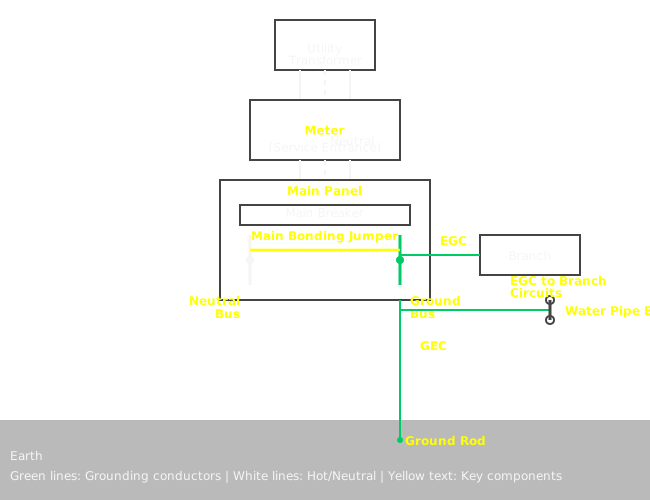
Grounding vs. Bonding: The Critical Distinction
Many electricians conflate grounding and bonding, but they serve fundamentally different purposes. Confusing them leads to unsafe systems and inspection failures. Let’s establish clear definitions before diving deeper.
Grounding: Connecting conductive elements to an earth ground (soil) to dissipate dangerous voltages and provide a reference point for the electrical system. The grounding electrode (rod, plate, or other method) is driven into earth.
Bonding: Connecting metallic elements together to create a continuous low-impedance path for fault current. Bonding ensures that if a conductor becomes energized by fault, all bonded metallic surfaces rise to the same potential, preventing shock hazard.
NEC Reference: NEC Article 250 covers all grounding and bonding requirements.
Simple Analogy
Grounding = path to earth (dissipation) Bonding = equipotential surfaces (equalization)
A well-grounded, well-bonded system means:
- Fault current has a low-impedance path to clear quickly
- No two surfaces have significantly different potential when a fault occurs
- Equipment and people are protected
Grounding System Components (NEC Article 250, Part III)
1. Grounding Electrode
The grounding electrode is the physical connection to earth. NEC 250.50 lists acceptable types:
| Electrode Type | Requirements | Notes |
|---|---|---|
| Rod (copper or galvanized) | 8 ft minimum length, 5/8 in. diameter | Standard in residential |
| Pipe (galvanized steel) | 2 in. diameter, 10 ft minimum buried | Less common; prone to corrosion |
| Plate (copper or steel) | Minimum 2 sq ft surface area | Requires at least 30 inches below grade |
| Building foundation (rebar) | Rebar encased in concrete | Effective when bonded properly; supplementary |
| Water pipe (metallic) | 10+ ft buried, bonded at service | Primary electrode in older homes; restricted now |
Modern practice: Install a copper rod as primary electrode. If available, supplement with a second rod 6+ feet away or install a ground ring around the building (NEC 250.52(A)(7)).
2. Grounding Electrode Conductor (GEC)
The GEC connects the service entrance to the grounding electrode(s). It’s typically a single conductor run from the service equipment to the electrode.
Size per NEC Table 250.66:
| Service/Feeder Conductor Size | GEC Size (Copper) |
|---|---|
| #14, #12 | #12 AWG minimum |
| #10 | #10 AWG |
| #8, #6 | #8 AWG |
| #4, #2 | #6 AWG |
| #1, #1/0 | #4 AWG |
| #2/0, #3/0 | #2 AWG |
| Over #3/0 | 12.5% of main conductor |
Example: A 200A service with #2 AWG service conductors requires a #6 AWG GEC.
Installation rules:
- Run GEC in conduit, cable, or attached to the surface
- Protect from physical damage
- Cannot splice (except where allowed; use exothermic welds or irreversible compression connectors)
- Connect to accessible, bonded service equipment
3. Main Bonding Jumper (MBJ)
Inside the service equipment, the main bonding jumper connects the neutral bus to the equipment ground bus. This is critical—it establishes the connection between the neutral (which carries return current) and all grounded metal (equipment).
Size per NEC 250.28(D):
- Use the same size as the larger of the two service conductor sizes
- For a 200A service with #2/0 aluminum, the MBJ is also #2/0 (or larger as needed)
Installation: The MBJ is typically a copper strap, screw-on terminal, or bus bar inside the main breaker enclosure. Some breakers have internal MBJs; verify with manufacturer specs.
Why it matters: Without the MBJ, the neutral and ground are floating separately, and fault current cannot flow properly back to the source.
Equipment Grounding Conductors (EGC)
Every circuit needs an equipment grounding conductor—a path for fault current to return to the service if a hot conductor touches metal.
EGC Types
1. Copper Wire (Most Common)
Sized per NEC Table 250.122 based on circuit breaker amperage:
| Breaker Amperage | Copper Wire | Aluminum/Copper-Clad |
|---|---|---|
| 15–20A | #14 AWG | #12 AWG |
| 30A | #10 AWG | #8 AWG |
| 40–50A | #8 AWG | #6 AWG |
| 60A | #8 AWG | #6 AWG |
| 100A | #8 AWG | #6 AWG |
| 150A | #6 AWG | #4 AWG |
| 200A | #6 AWG | #4 AWG |
| Over 200A | As per code or engineer |
Example: A 20A circuit requires #12 AWG minimum for the EGC. If you upsize the phase conductors to #10 for voltage drop, you don’t need to upsize the EGC—it remains #12 (tied to breaker amperage, not wire size).
2. Metallic Conduit as EGC
Steel or aluminum conduit can serve as the equipment grounding path if:
- Properly sized and installed per NEC 250.118
- All connections are tight and bonded
- Listed fittings are used
- Conduit is not damaged
EMT (electrical metallic tubing) is commonly used and is acceptable as an EGC.
3. Armored Cable (AC) Sheath
Type AC cable (armored) has a bonding strip that serves as an EGC when properly terminated and continuous.
4. Metal-Clad Cable (MC) with EGC
Some MC cables include an integral green EGC wire. Others rely on the armor as the path (when bonded) or use a separate EGC.
EGC Routing Rules
- Must be in the same raceway, cable, or enclosure as the circuit conductors (NEC 300.3(B))
- Cannot be run separately except in specific circumstances (like service entrance)
- Must be continuous (no splices except for certain listed connectors in the right situation)
- Must be green or green with yellow stripe (if insulated); can be bare if in cable assembly
Bonding Jumpers (Not the Same as EGC)
Bonding jumpers are short conductors that connect metallic elements together to maintain equipotential surfaces. They’re different from equipment grounding conductors.
Types of Bonding Jumpers
1. Main Bonding Jumper (MBJ) — Inside service equipment, connects neutral to ground
2. Supply-Side Bonding Jumper — On the supply side of the service, bonds service conduit/enclosures
3. Equipment Bonding Jummer — Bonds metal equipment frames, enclosures, and raceways together
4. Jumpers at Disconnects — Where conduit connections exist, a bonding jumper (or appropriate fitting) ensures continuity
Bonding Jumper Sizing
For bonding jumpers, size per NEC 250.102(D):
| Largest Phase Conductor | Bonding Jumper (Copper) |
|---|---|
| #14, #12 | #14 AWG minimum |
| #10, #8, #6 | #10 AWG minimum |
| #4, #2 | #6 AWG |
| #1, #1/0, #2/0 | #4 AWG |
| #3/0, #4/0 | #2 AWG |
| Over #4/0 | 12.5% of phase conductor |
Example: A service feeder with #2 AWG phase conductors requires a #6 AWG bonding jumper where the conduit enters the building.
Grounding Electrode System Installation
The Complete Electrode System
A properly designed grounding electrode system includes:
- Primary electrode: Usually a copper rod driven 8 feet into earth
- Bonding conductors: Connect all electrodes together
- GEC: Runs from service to the electrode system
- Metal water pipe (if present): Must be bonded to the grounding electrode system within 5 feet of where the water pipe enters the building (NEC 250.53(D))
- Building steel (if present): If the building has structural steel, it should be bonded to the electrode system
Electrode Testing and Resistance
The NEC doesn’t mandate a specific resistance value, but the industry best practice is:
- Single electrode: Less than 25 ohms
- Two electrodes (recommended): Less than 10 ohms
- Driven after installing one rod: If first rod exceeds 25 ohms, install a second rod at least 6 feet away
Testing method: Use a clamp-on ground tester or fall-of-potential method. Testing is especially important in areas with high soil resistivity (sandy, rocky, dry soil).
Common Grounding/Bonding Mistakes
Mistake #1: No Main Bonding Jumper
Some installations lack an MBJ or have a broken/corroded connection inside the service. Without it, fault current cannot flow back to the transformer (the source), and shock hazard persists.
Inspection failure. Install the MBJ properly per NEC 250.28(C).
Mistake #2: Water Pipe as Only Electrode
Older code allowed metallic water pipes as the sole grounding electrode. Modern NEC requires a supplementary electrode (like a rod) whenever possible, because water pipes are increasingly replaced with plastic.
Fix: Drive a copper rod, bond it to the water pipe within 5 feet of entry, and use both.
Mistake #3: Wrong EGC Size
Using #14 AWG for a 30A circuit is a code violation. Many electricians size the EGC to the wire size, not the breaker. This is wrong. Always use NEC Table 250.122.
Remember: The EGC is sized to the breaker amperage, not the circuit conductor size.
Mistake #4: Bonding Jumper Instead of EGC
Some installations use a bonding jumper (thinner) where an equipment grounding conductor (thicker) is required. A #10 bonding jumper is not equivalent to a #10 EGC—the EGC carries more current during a fault.
Mistake #5: Conduit-Only Grounding
Relying solely on conduit as the EGC without proper bonding at terminations. Conduit joints must be listed fittings and tight. Loose connections defeat the purpose.
Best practice: Use a separate green wire EGC in addition to conduit, especially in high-hazard areas or where moisture is present.
Real-World Scenario: Service Upgrade
A 100A service is being upgraded to 200A. What grounding/bonding work is required?
Current state:
- Existing copper rod electrode (8 ft long, 5/8 in. diameter)
- Existing GEC: #6 AWG copper
- New service entrance will use #2/0 aluminum
Required upgrades per NEC:
-
Check electrode resistance: Test with a clamp-on tester. If > 25 ohms, drive a second rod 6 feet away and bond together with #6 AWG copper conductor.
-
Upsize GEC: Per NEC Table 250.66, #2/0 aluminum service requires #2 AWG copper GEC. The existing #6 is too small. Upsize to #2.
-
Main bonding jumper: The new service must have an MBJ inside the panel. If the old service had one, ensure the new panel also has one (size per NEC 250.28, using the larger of the two service conductor sizes).
-
Bond water pipe (if present): If metallic water pipe enters within 5 feet of the new service location, bond it to the grounding electrode system with a #2 AWG conductor within 5 feet of entry.
-
Check conduit bonding: If service conduit is run to the electrode, ensure proper bonding jumpers at terminations.
Code References Quick List
- NEC Article 250: Grounding and bonding (the whole article is essential reading)
- NEC 250.20: Effective grounding path requirement
- NEC 250.28: Main bonding jumper requirements
- NEC 250.50: Grounding electrode types
- NEC 250.52: Installation of grounding electrodes
- NEC 250.53: Bonding of grounding electrodes
- NEC 250.66: Grounding electrode conductor sizing
- NEC 250.102: Bonding jumper sizing
- NEC 250.118: Types of equipment grounding conductors
- NEC Table 250.122: Equipment grounding conductor sizing
Inspection Checklist: Grounding and Bonding
- Grounding electrode installed (rod, plate, etc.)
- GEC sized per Table 250.66 and connected to electrode
- Main bonding jumper present in service equipment
- All service equipment bonded together
- All circuits have EGC per Table 250.122
- Water pipe bonded within 5 feet of entry (if present)
- Building steel bonded to electrode system (if present)
- Conduit/raceway bonding confirmed at all terminations
- No open or broken connections
- GEC protected from physical damage
- Electrode resistance tested (< 25 ohms preferred)
Takeaway
Grounding and bonding are not optional—they’re the foundation of electrical safety. A well-designed grounding electrode system with proper bonding ensures that fault current flows back to the source safely, protecting equipment and people. Master NEC Article 250, understand the difference between grounding (earth connection) and bonding (equipotential surfaces), and size conductors correctly per the tables. When an inspector asks you to explain your grounding system, you’ll have the answer backed by code.