Electrical Conduit Bending Basics: Offsets, Kicks, and Saddles
The Math Behind Every Bend
Conduit bending is applied trigonometry. Every offset, saddle, and kick follows the same geometric principles as pipe offsets — the difference is that you’re forming the bends in the field with a hand bender rather than using pre-made fittings.
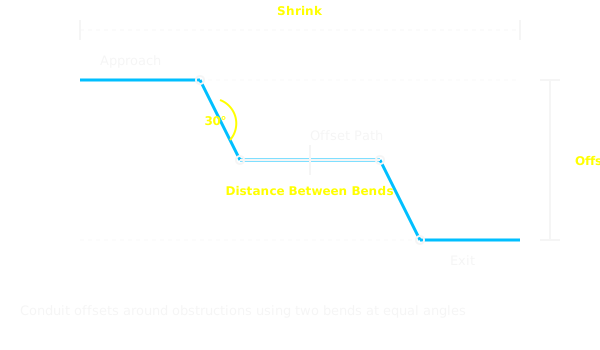
The three values you need for every offset bend: the offset distance (how far the conduit needs to move), the angle of the bends, and the distance between bends on the conduit.
Offset Bends
An offset bend moves the conduit from one plane to another — around an obstruction, between a panel and a wall, or to align with a knockout.
The formulas: Distance between bends = Offset × Multiplier Shrink = Offset × Shrink constant
Multipliers by angle:
| Bend Angle | Multiplier | Shrink per inch of offset |
|---|---|---|
| 10° | 6.0 | 1/16” |
| 22.5° | 2.6 | 3/16” |
| 30° | 2.0 | 1/4” |
| 45° | 1.414 | 3/8” |
| 60° | 1.155 | 1/2” |
Worked example: 6-inch offset at 30°. Distance between bends = 6 × 2.0 = 12 inches between bend marks. Shrink = 6 × 1/4 = 1.5 inches — the conduit will be 1.5 inches shorter along its run after the offset.
Why Shrink Matters
When conduit makes an offset, it consumes horizontal run. If you measure your conduit run as a straight line and then add an offset without accounting for shrink, the conduit will come up short at the far end.
For a 6-inch offset at 30°, your conduit shortens by 1.5 inches. At 45°, the same offset costs 2.25 inches. On a tight run with multiple offsets, these shrink values accumulate and will throw off your measurements if ignored.
Account for shrink by adding the shrink value to your overall conduit length before cutting, or by adjusting your mark placement accordingly.
90-Degree Bends (Stub-Ups)
A 90-degree bend is the simplest: you’re bending the conduit to go from horizontal to vertical (or vice versa). The key measurement is the stub length — the distance from the end of the conduit to the back of the bend.
Every bender has a take-up value (also called deduct) — the distance from the mark on the conduit to where the bend actually forms. This value varies by conduit size:
1/2” EMT: 5” take-up. 3/4” EMT: 6” take-up. 1” EMT: 8” take-up.
To make a 12-inch stub with 1/2” EMT: mark the conduit at 12 - 5 = 7 inches from the end. Place the mark at the arrow on the bender and bend to 90°.
Saddle Bends
A saddle bend goes over an obstruction and returns to the original plane — like going over a pipe that crosses your conduit path. A three-bend saddle uses a center bend (usually 45°) flanked by two equal-and-opposite bends (usually 22.5°) on each side.
For a 3-bend saddle over a 2-inch obstruction: Center bend: 45° at the center of the obstruction. Outer bends: 22.5° each, spaced at 2 × 2.5 = 5 inches from center on each side. Shrink: 2 × 3/8 = 3/4 inch (center bend shrink).
The 2.5 multiplier for the outer bend spacing comes from the 22.5° offset multiplier (2.6, rounded for practical use).
Kick Bends (Back-to-Back 90s)
A kick is a shallow bend — typically 10° to 30° — used to angle conduit slightly without a full offset. Kicks are common for routing conduit away from walls or aligning runs with panels.
The math is simpler: just apply the bend at the desired point. The shrink is minimal for small kicks (a 10° kick on a 3-inch offset only costs 3/16 inch), but account for it on precision runs.
Practice Makes the Math Automatic
The multipliers and shrink constants become second nature after bending a few hundred sticks of conduit. Until then, a quick reference helps — and checking your layout math before bending saves conduit.
For quick field calculations: FieldLab Electrician NEC Calculator →