How to Calculate Compound Miter and Bevel Angles for Crown Molding
Understanding Compound Angles
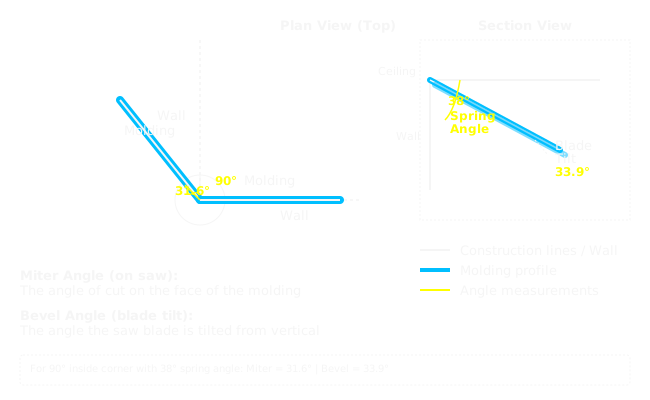
Compound miter angles exist where two different angle planes intersect. Crown molding is the classic example: the molding sits at a spring angle (usually 38° or 52°) to the wall, and you’re cutting it at a miter where two walls meet. The result is both a miter angle (horizontal cut) and a bevel angle (vertical tilt). Get one wrong and your joints won’t fit flush.
The Core Formula
For compound angles, you need two pieces of information:
- Spring angle: The angle at which the molding sits against the surface (for crown, typically 38° or 52°)
- Wall angle: The angle where two surfaces meet (usually 45° for inside/outside corners, but can be 30°, 60°, or any value)
The relationship uses tangent functions:
Miter angle = arctan(tan(wall angle / 2) / cos(spring angle))
Bevel angle = arcsin(sin(spring angle) × sin(wall angle / 2))
For practical purposes, use a compound angle table. These are calculated from the formulas above and will save you trigonometry on the job.
Common Crown Molding Angles
52° Spring Angle (More Common)
| Wall Angle | Miter Cut | Bevel Cut |
|---|---|---|
| 90° (flat corner) | 45.0° | 38.6° |
| 120° (obtuse) | 33.7° | 31.2° |
| 135° | 27.0° | 23.0° |
| 60° (acute) | 60.4° | 48.2° |
38° Spring Angle (European Moldings)
| Wall Angle | Miter Cut | Bevel Cut |
|---|---|---|
| 90° (flat corner) | 45.0° | 27.0° |
| 120° (obtuse) | 37.0° | 19.5° |
| 135° | 30.5° | 14.8° |
| 60° (acute) | 58.8° | 35.2° |
Step-by-Step Layout Process
1. Identify Your Spring Angle
Check the back of your crown molding. Measure the angle from the back surface to the wall contact point. Standard angles:
- 52°: American interior crown (most common)
- 38°: Steeper European profiles
- 45°: Architectural or specialty molding
If measuring, use a digital angle finder against the back of a sample piece held at its intended angle on a reference block.
2. Determine Wall Angle
- 90° corners: Standard drywall framing
- Obtuse (120°-135°): Cathedral ceilings or sloped walls
- Acute (60°-75°): Angled roof valleys or curved walls
Measure with an angle finder in the corner where molding will meet, or calculate from roof pitch if it’s a sloped application.
3. Calculate or Look Up Your Angles
For 52° crown on a 90° corner (most common residential):
- Miter angle: 45°
- Bevel angle: 38.6°
Practical method: Reference a compound angle table (available in Crown-Pro app or print from specialty trim sites). Match spring angle + wall angle = your two cut angles.
4. Set Your Miter Saw
For compound cuts, a dual-bevel miter saw is essential:
- Set the miter angle (table rotation) first
- Then set the bevel angle (blade tilt)
- Make a test cut on scrap material
- Verify the joint dry-fits to your corner without gaps
Critical: Blade tilt direction matters. The bevel must tilt toward the spring angle. If cuts are facing opposite directions, one needs bevel tilting left and one tilting right.
Hip and Valley Rafter Trim (Roof Applications)
When cutting trim for roof hip or valley lines, the spring angle becomes the slope of the roof.
Example: 45° roof (12:12 pitch) with hip trim
- Spring angle: 45° (the roof slope)
- Wall angle: 90° (standard hip intersection)
- Use 45° miter and 38.6° bevel
The molding sits along the hip line at the roof’s slope angle, so your spring angle IS your roof pitch angle.
Common Mistakes and Fixes
Problem: Molding gaps at the joint
- Check you’re using the correct spring angle for your stock
- Verify wall is actually 90° (out-of-square walls require custom calculations)
- Ensure blade is sharp (dull blade causes poor fit)
Problem: Molding doesn’t sit flush to wall
- Bevel angle is wrong direction
- The corner surface isn’t flat or is damaged
Problem: Miter angle perfect but bevel creates gaps
- You’ve set bevel on wrong axis; reverse the tilt direction
- On compound cuts, always test fit on scrap first
Setting Up for Production Cuts
When cutting multiple pieces (a room’s worth of crown):
- Make a setup cut on scrap from the same stock
- Test fit the scrap in your intended corner
- Adjust saw angles until test piece sits perfectly
- Lock all settings and cut production pieces without changing anything
- Verify every 3-4 pieces that nothing’s shifted
Store your angle settings in notes for future jobs—different crown profiles or roof pitches will require different numbers.
Using Speed Square and Jig Method
For contractors without a dual-bevel saw, a table saw or band saw can work with guides:
- Set up a jig that holds molding at the spring angle against the blade
- Mark both cut lines on the piece using the miter and bevel angles
- Use a speed square to draw the bevel line at the correct angle
- Make the miter cut first (crosswise across the molding)
- Rotate the piece and make the bevel cut (lengthwise) using the marked line as a guide
This is slower but works when you have 4-5 pieces to cut and don’t have the right power tools.
IRC References
Building codes don’t prescribe how to cut crown molding, but trim must be securely fastened (IRC 702.1). For roof applications, hip and valley trim must be properly aligned and fastened per the roofing section. Verify local amendments before proceeding.
Quick Reference Card
For 52° crown molding on standard 90° corners:
- Miter saw: Set miter to 45°, bevel to 38.6°
- Test fit first
- Both pieces need the same settings if cutting mirror images
For 45° roof pitch hip or valley trim:
- Use compound angle table with 45° spring angle and 90° wall angle
- Result: 45° miter, 38.6° bevel
- Ensure pieces mirror each other at the ridge or valley
For non-standard corners:
- Measure the actual wall angle with a digital angle finder
- Look up angle combination in a compound angle table
- Make test cuts on scrap material before cutting finished stock